

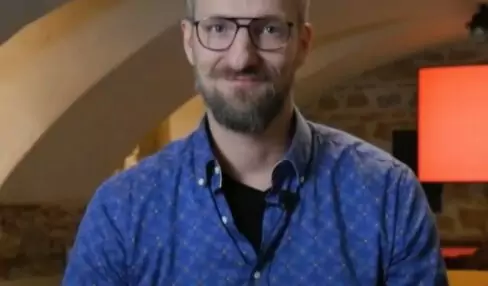
« Become a specialist in computer programming applied to the video game industry. The aim of these 2 years of training in the MSc Video Game Developer, Real-Time 3D Rendering and Immersive Technologies is to develop highly technical skills so that you master all the tools and methods used to produce a video game.
Through our modules in management and technical project management, you will also be able to meet the demands of positions of responsibility.
Finally, you will boost your employability throughout your studies through professional experience (by securing two years of work-study). It is the best way to put your skills into practice and learn your future job alongside professionals. »
The G. Tech teaching team
| Accredited training body: | Gaming Campus |
| Gaming Campus diploma: | MSc Video Game Developer, Real-Time 3D Rendering and Immersive Technologies |
| Bridges / Further study: | See further study options within our programmes |
| Prerequisites: | 180 or 240 ECTS credits validated
Degree in computer science / a scientific field or from an engineering school |
| Tuition fees: | See the “Funding” section. |
| Total programme length: | 2 years (450 hrs / year) |
| Assessment: | Continuous assessment: throughout the year via end-of-project assessments (written reports, oral presentations, knowledge checks during the project…)
Exams: at the end of each semester, individual assessments of the skills acquired |
| Campus: | Paris, Lyon, Bordeaux and Online (Online: 75% of the programme remote / specific projects and exams at the nearest campus) |
| Format: | Work-study rhythm: 3 weeks / 1 week |
| Average class size: | 30 students |
| Pass rate: | class of 2025: 100% |
| Satisfaction rate: | 87,52% |
| Employment rate at 6 months (class of 2025): | 70% |
| Contract termination rate: | 9% |
| Dropout rate during the programme (2024-2025): | <5% |
| Next intake: | September 2027 |
| Disability: | Click here to find out about our arrangements for welcoming and supporting people with disabilities |
By the end of the programme, you will be:
• An expert in software development for video games (complex algorithms, randomisation, procedural generation, optimisation) and in rendering systems (Unity 3D, Unreal Engine, custom engines and the engines most used in the industry).
• Prepared for management and technology project management.
The teaching is specialised and in-depth to meet the needs of studios looking for rare, highly skilled profiles.
• Around fifteen projects a year, individually or in groups
• Creation of a complete game demo
• 90% of your lecturers are working video game professionals
• Course material sent ahead of each project, then your lecturer becomes your coach
• Two years of work-study
• Meetings with professionals and masterclasses all year round
• Company and studio visits
• Develop your soft skills and teamwork
• Become a confident speaker and improve your leadership
• Fluent, professional English by the end of the MSc, with learning in small groups.
• Take part in one of the Learning trips: Canada, Japan, Korea (optional)
• You can also learn Chinese, Korean, Japanese, Spanish or Italian.
• Courses available online on the Gaming Campus Online platform
• Remote learning possible to suit your work-study needs
• High-end equipment on our campuses: OMEN computer rooms, esports arenas, streaming studios, VR room…
• Video game and esports student societies
REQUEST A BROCHURE
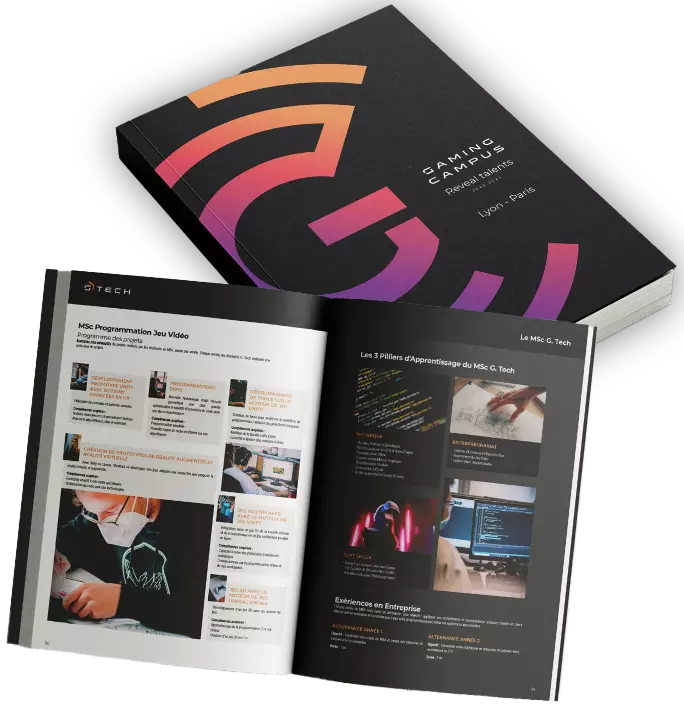
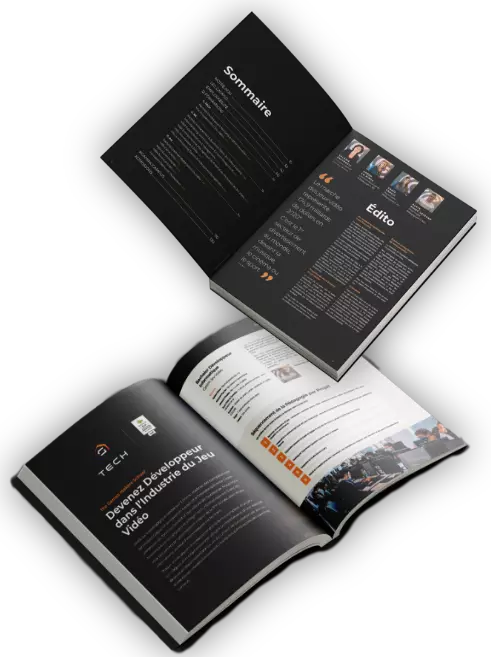
178 pages to discover G. Tech, the MSc Video Game Developer and Real-Time 3D Rendering and the 18 other Gaming Campus programmes. Plenty of exclusive content to better understand our schools' positioning and why Gaming Campus is unique
All our programmes, including the MSc Video Game Developer and Real-Time 3D Rendering, have been built in direct collaboration with industry professionals. Drawing on their insight and expertise, we designed them to match recruiters' expectations and adapt to changing careers. Once a year, with our advisory board (made up of 18 professionals), we improve and adjust their curricula so that we always offer innovative programmes.

Development of a 2D/3D game with a game engine.
Skills acquired:
• Learning C++ programming in Unreal
• Creating a 2D/3D game in C++
Use of advanced concepts and patterns.
Skills acquired:
• Advanced C# concepts for writing more efficient, clear and optimised code.
Development of a small graphics game engine, which can then be used to create games on this in-house platform.
Skills acquired:
• Development of the modules needed to create a game engine.
• In-depth knowledge of low-level code and engine optimisation.
Development of a terrain or map generator.
Skills acquired:
• Procedural algorithms, graph theory.
• Solution optimisation.
Development of a physics engine.
Skills acquired:
• Advanced algorithms for physics management (collision, movement).
Using the Vulkan library to display content and for GPU computing.
Skills acquired:
• GPU programming.
• Compilation and C++ for the graphics card.
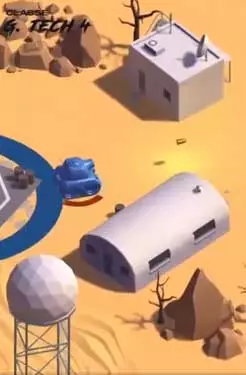
An introduction to artificial intelligence through creating a game in the Unity game engine.
Skills acquired:
• AI navigation
• State machine
• Machine learning
• Behaviour trees

Integrating the network layer into a 3D game and turning it into a multiplayer game playable online.
Skills acquired:
• Ability to create playable multiplayer prototypes
• Knowledge of online programming and its constraints
Creating and programming tools to improve the workflow of programmers / artists or game/level designers.
Skills acquired:
• Mastery of the Unity Editor library
• Ability to add modules to Unity
A new multi-threaded technology enabling greater optimisation, faster code execution and easier maintenance.
Skills acquired:
• Parallel programming
• A new way of coding and iterating on your algorithms
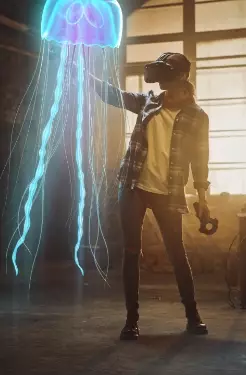
With Unity or Unreal, students learn to design virtual and augmented reality (AR/VR) games.
Skills acquired:
• Gameplay adapted to these specific tools.
• Code optimisation for these technologies.
• Introduction to metaverse development.
by MSc students
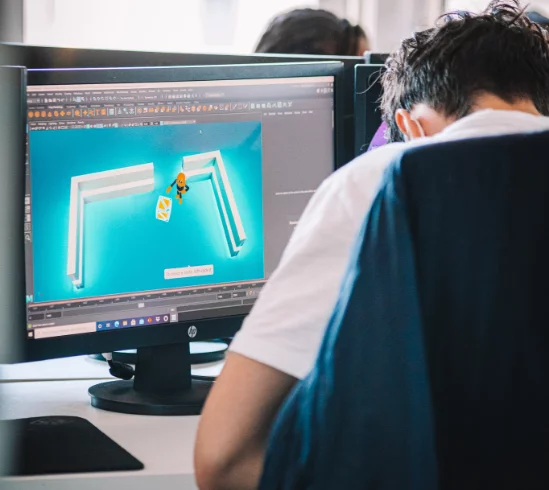

In your final year, as a common thread, you create your own video game. You work with MBA students from G. Art and G. Business.
A great team adventure in which you will have time to imagine, create, develop and market your own video game!
12 months of exchanges, successes and failures that will enable you to master the creation of a video game from A to Z in your own field of expertise and in the other disciplines too.
At the end of your project, you will present your game to industry professionals invited by Gaming Campus. The best games will have the opportunity to be showcased at video game trade shows.


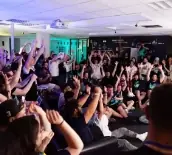
A-Live Event = €77,214 raised for the Institut Analgésia!
G. Tech MSc students, supervised by expert lecturers and volunteers from Loisirs Numériques, organised a charity streaming event from A to Z.
• concept
• brand and positioning
• recruiting streamers
• pre-event communication
• event logistics
• communication during the event
• merchandising
For 52 hours, dozens of streamers took turns at Gaming Campus Lyon to host streams and raise donations.
An exceptional experience, both for gaining new skills in real-life conditions and for the pride of raising funds for a charity.
Relive their adventure on the event's Twitter account.
“This project helped me understand the overall organisation of a charity event.”
Robin L. – G. Business 3 student

Immersion by Gaming Campus is a key moment in our schools' approach to teaching.
For 2 weeks, all our students, whatever their programme, level of study or specialisation, come together to immerse themselves in the industry they are training for.
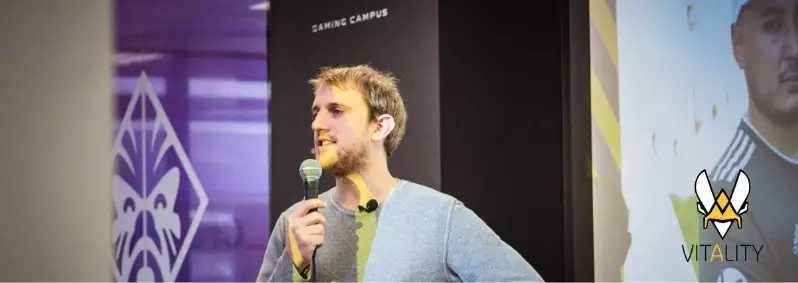

MATHILDE YAGOUBI
Managing Director - Game Only

VIVIEN CAUHÉPÉ
Senior Live and Monetization Manager - Ubisoft

ZACK NANI
Content creator

PIERRE LAMOURE
Senior Communication Specialist - Electronic Arts

JULIE JEANNIOT
Brand Manager - Riot Games

FABIEN DEVIDE
Founder - Team Vitality

These video game professionals present their speciality.
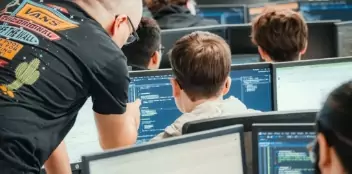
Professionals regularly share their expertise on specific topics.

Presentation of the business or job opportunities of companies that come to meet students.
• Advanced and specialised modules
• Advanced mastery of Unity and Unreal Engine
• Online programming
• Engine / graphics programming
• Parallel programming
• Code optimisation
• Augmented reality and virtual reality
• Fundamentals of responsible computing

• Starting a business and business plan
• Video game financing
• Managing a studio relationship

• Being able to resolve conflicts
• Communicating within a team
• Working in multidisciplinary teams






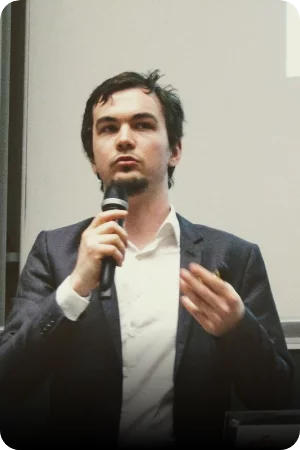


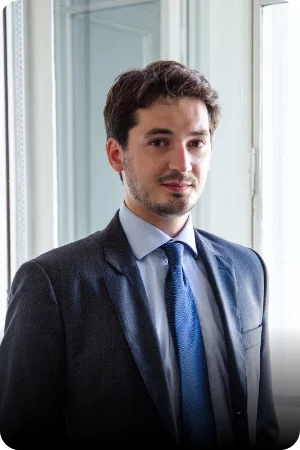
1st-year work-study:
A work-study placement to immerse yourself in the industry and use all the skills and knowledge acquired during your studies. Gain valuable experience by working closely with your lead programmer and the production team.
Students will develop complete modules that are integrated directly into the game: core gameplay mechanics such as adding new powers, developing new bosses or implementing enemy artificial intelligence, for example. Students will also work at the same pace as the other programmers (in sprints, for example), take part in meetings with game designers / artists, and contribute their views and ideas to development.
2nd-year work-study:
Work ¾ of the time in the company and ¼ at school or remotely, then secure a contract with the game studio at the end of your work-study.
During this work-study year, the student is a fully fledged member of the development team. Building on the experience gained during the first work-study year, the student already knows the ropes and can be competent and as autonomous as possible straight away. The tasks are similar to those of a junior programmer. The specific 5th-year modules taught at Gaming Campus help them reach a more advanced level and put it straight into practice.


Eden Games
Game developer

Ubisoft Ivory Tower
Assistant
game developer


Artefacts Studio
Developer
Unreal Engine 4


Eden Games
Game developer


While we encourage each student to be independent in finding their work-study placement, our teaching team is on hand to facilitate and support the process and applications. Students can draw on our network of 200 companies in the industry, on contacts made at events organised on campus such as masterclasses, or reach out to our industry lecturers.
Your corporate relations contact: contact@gamingcampus.fr

Being a software developer for video games means being bilingual in English: the two go hand in hand, and recruiters will treat it as an essential requirement. On the MSc, language skills are therefore at the heart of learning, preparing you as well as possible for your future employability.
Language practice: by the end of your MSc, you will be able to understand, speak and write the language of Shakespeare thanks to our modules and unique teaching. To go further and round out your language skills, G. Tech also offers a second and third foreign language from the following: Chinese, Korean, Japanese, Spanish or Portuguese.
Learning trip: discover gaming in Canada, Japan and South Korea on our immersion trips to the heart of the great video game nations.
In addition to their studies, every student is encouraged to get involved in one of the student societies that make up life at Gaming Campus. They can also found one. Every initiative is welcome and counts towards the final grade.
Taking part in online video game matches, organising and promoting competitions: members of this esports society can do a bit of everything.
From their Twitch channel, members create and broadcast content about geek and pop culture.

The Student Union organises events both within and outside school.
Its members play board games.
The junior enterprise run by students of the Gaming Campus schools.
This programme is available in Paris, Lyon, Bordeaux, Online or on our Online Campus (from home). Our campuses are designed as true gaming worlds where everything has been built to encourage learning and performance: 6,500 m2 in total, 30+ work and living spaces (computer rooms, VR Room, artists’ studio, sports arena, shaker, immersion rooms, language rooms…
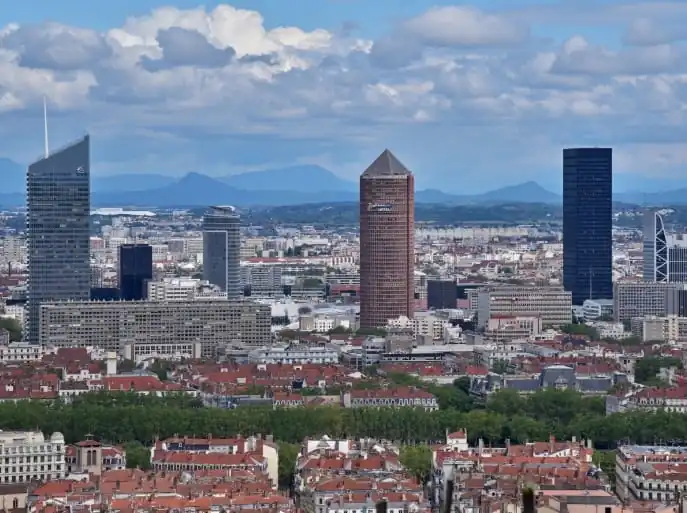
Gaming Campus Lyon is located in the lively Part-Dieu district, in the heart of the city. Right next to Lyon Part-Dieu station and served by numerous metro, tram and bus lines, our campus enjoys a strategic, well-connected location. This central, vibrant setting offers quick access to services and amenities, while remaining close to Lyon's major university and business hubs. See the campus.
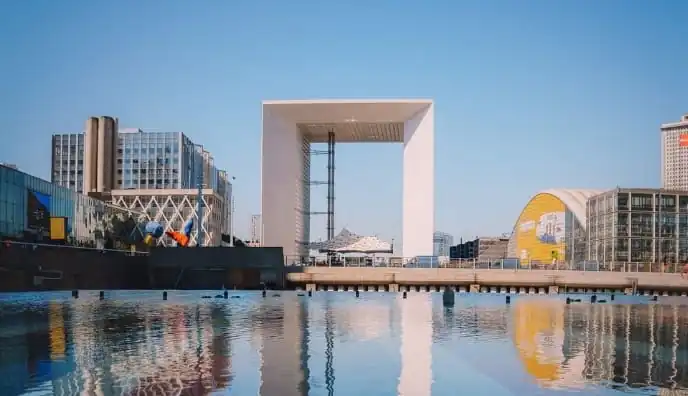
Gaming Campus Paris is located in La Défense. Close to businesses, students at our schools enjoy exceptional conditions and brand-new premises. It is easy to reach, right next to RER A, Metro line 1 and tram line 2. See the campus.
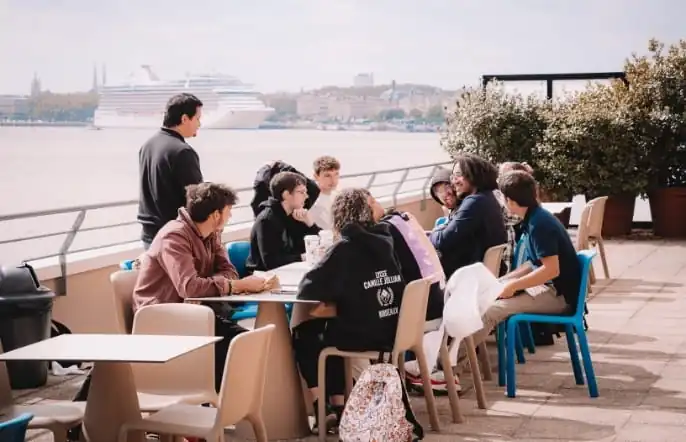
Bordeaux has a unique appeal and remarkable energy, especially for higher-education students. Gaming Campus has therefore set up on the Quai des Chartrons (at Hangar 16), right in the heart of Bordeaux, making it easy to reach via the many public transport options (tram, bus, river shuttle and bikes). See the campus.
Students on this programme have access to Gaming Campus Online, an online learning platform. Custom-built, this online campus also helps students get to grips with new ways of working, especially remote working. The platform is used to complement the programme. The remote version of the programme includes compulsory in-person sessions (see our programmes).
Attend live classes and masterclasses, enjoy replays available 7 days a week, interact live with lecturers and other students…
- Study from home (no accommodation or travel constraints)
- Join your class made up of on-campus and remote students (identical programme)

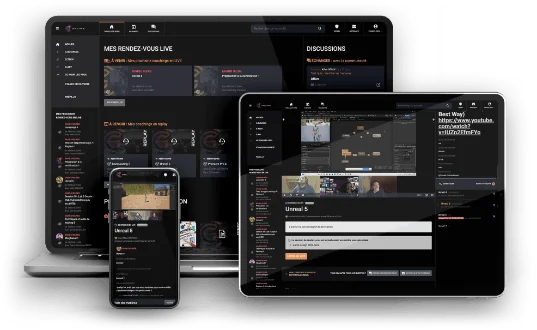
Attend live classes and masterclasses, enjoy replays available 7 days a week, interact live with lecturers and other students.









G. Tech 4 student, BTS Digital Systems

G. Tech 4 student, Bac S (science baccalaureate)
G. TECH 4 student, BTS Digital Systems

G. TECH 4 student, BTS Engineering Sciences

G. TECH 4 student, Licence in Computer Engineering
G. TECH 4 student, BTS SIO

G. TECH 4 student, BTS IT Development
G. TECH 4 student, Licence in Networks and Computer Engineering
Admissions
Hold a Bac+3 in computer science for video games or general computer science, subject to application review.
Funding
Tuition fees are €10,400 incl. VAT* per year for the Mastère years for the 2027 – 2028 intake.
(*) Price for payment in a single instalment. Payment in several instalments possible under certain conditions. Payment can be made in 1, 3 or 10 instalments. Stopping your studies due to force majeure (serious and disabling illness, accident, death of a relative) ends the direct debits.
Compare with other programmes, work-study and the 3 or 10 instalment schedule: the price of our Mastère and MSc programmes compared with Bachelors.
| Pre-registration | €650 incl. VAT |
| Single payment Mastère | €9,750 incl. VAT |
| Payment in 3 instalments | €10,000 incl. VAT |
| Payment in 10 instalments | €10,100 incl. VAT |
Financial aid
Work-study in a company: From the 4th year, work-study is offered in three forms:
– students are enrolled in initial training with student status (FISE), alternating between school and company under an internship agreement
– You can switch to initial training with apprentice status (FISA) as soon as you sign an apprenticeship contract, as we have been an apprentice training centre (CFA) since September 2021.
– We also offer the professionalisation contract.
The teaching team and our employability manager help you find a work-study placement and negotiate your pay.
Student loan on preferential terms: LCL is G. Tech's main banking partner. You can obtain special loan terms for your MSc and a privileged relationship. Feel free to contact us for more information.
State-guaranteed student loan: since June 2020, the French State can act as guarantor for your loan to make it easier to obtain. Visit the Etudiant.gouv.fr website to find out more.
Campus jobs: Small jobs helping to develop the campus are sometimes available. The teaching team also gathers and shares part-time jobs near the campus.
Local council support: Check with your town of residence, or your parents', to see whether you are eligible for the Student Minimum Income (RME). Not all towns offer the RME. It is awarded by the CCAS (municipal social action centre).
Departmental support: For grant-holding students, departmental councils offer annual grants or interest-free loans.
Fondation de France support: 120 foundations award grants and interest-free loans. We encourage you to contact the Fondation de France to find out more.
Finding accommodation: We help you find accommodation through our network of housing partners. We have built close relationships with student residences near the campus.
MSc Video Game Programming Open Days
Ask your questions about the MSc Video Game Programming
Discover G. Tech, Gaming Campus and our 4 schools live during an Open Day, from home or in person on our premises. We will cover the MSc Video Game Programming in particular, and you can ask our teaching team all your questions. Open Days are the most effective way to form an opinion of our programmes. If you have decided to apply for one of our programmes, they are also useful for preparing your application as well as possible and maximising your chances.
DETAILED PROGRAMME:
– Tour of our campuses and living spaces (coworking spaces, computer labs…)
– Presentation of each school and its video game degrees (work-study available)
– Testimonials from our students and industry professionals
– Live Q&A with our Managing Director Valérie Dmitrovic, your programme managers and our students
– How to join Gaming Campus (outside Parcoursup)?
REVIEWS:
Rayane C. ⭐⭐⭐⭐⭐
The live session was visually appealing and smooth. It was very informative and answered several of my questions.
Emma G. ⭐⭐⭐⭐⭐
I liked it because we got to see several interviews with students and got answers to our questions. Thank you..
Thierry Z. ⭐⭐⭐⭐⭐
Very useful, the moderators are very active and answer every question.

If you would like more information about the MSc programme offered by G. Tech, internships, our company network or our project-based teaching, get in touch with our teaching team. They will answer all your questions.
Apply for the programme
Simple application, quick response:
September 2027 intake: Applications open
We have chosen an application process with no competitive exam and without going through ParcourSup or Mon Master. This allows us to review each application individually and maximise equal opportunities and each candidate's potential. It also lets us give the academic background the same weight as the career plan. Finally, with a short admissions process based on dialogue, we hope to reduce students' stress when looking for a programme.
Apply now
For any problem sending this form, write to contact@gamingcampus.fr